The best operation for cholangiocarcinoma depends first on where the tumour sits, then on whether it has spread into vessels, lymph nodes or distant organs. By comparing the three surgical patterns, staging tests, drainage choices and treatment goals, you can arrive at a more informed discussion with an HPB team in Pune.
Key takeaways
- Tumour location determines whether surgery involves the liver, bile duct or pancreas.
- CT, MRI, MRCP and staging tests assess blood-vessel involvement and spread.
- Drainage can relieve jaundice before treatment when bile flow is blocked.
- Compare HPB expertise, multidisciplinary care and the surgeon’s planned operation.
Which type of cholangiocarcinoma determines the operation?
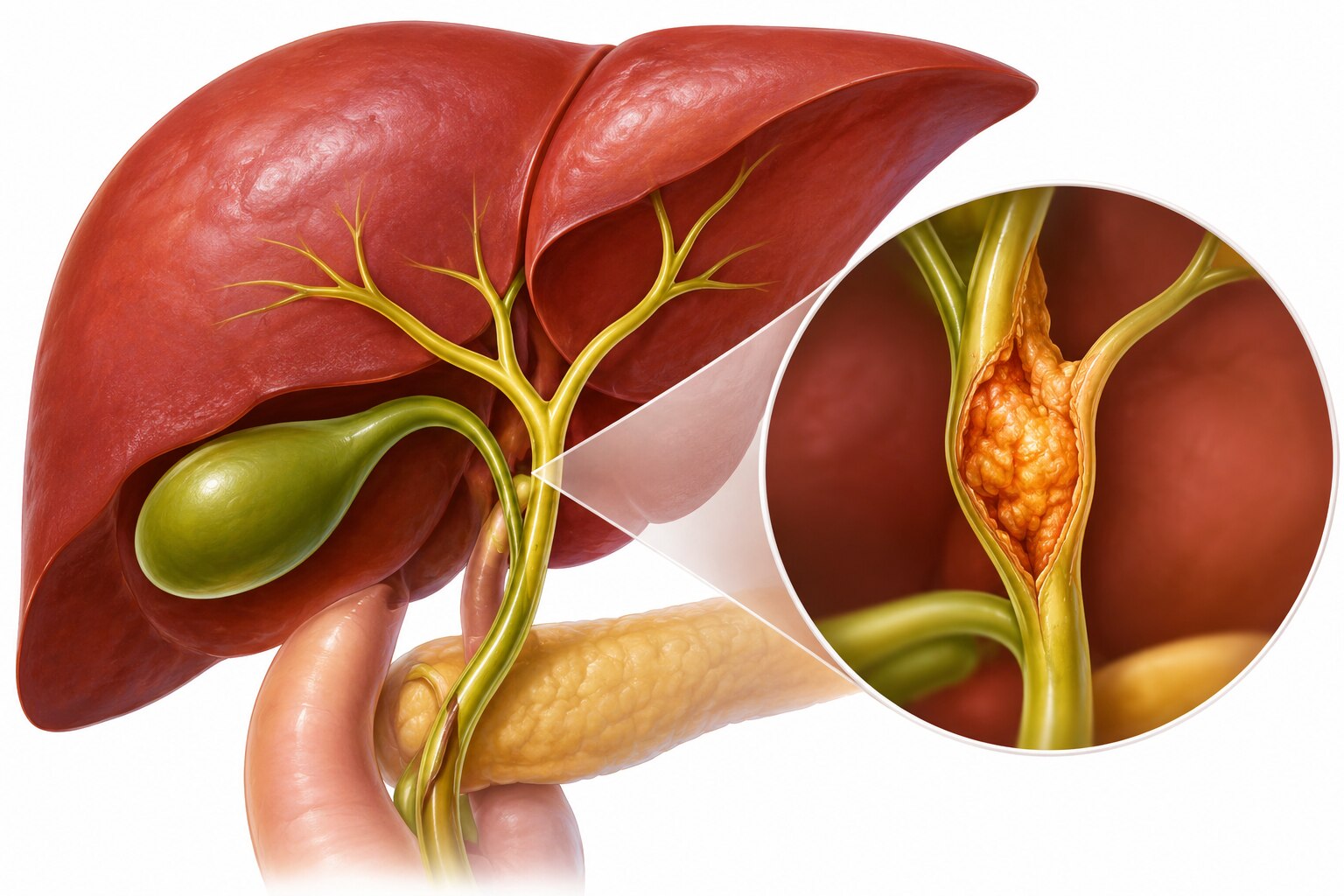
Location determines the operation for cholangiocarcinoma: the tumour may start inside the liver, at the bile-duct junction, or farther down near the pancreas and duodenum.
| Type | Where it arises | Operation usually considered |
|---|---|---|
| Intrahepatic | Within the liver | Liver resection removing the tumour with an adequate margin; regional lymph-node assessment when appropriate |
| Perihilar, hilar or Klatskin | At the bile-duct junction near the liver | Extrahepatic bile-duct removal, right or left hepatectomy, caudate-lobe resection, lymph-node dissection and Roux-en-Y hepaticojejunostomy to restore bile flow |
| Distal extrahepatic | Near the pancreas and duodenum | Selected patients need pancreaticoduodenectomy, or Whipple procedure, rather than isolated bile-duct removal |
The curative target is an R0 resection: no visible tumour remains and laboratory examination finds microscopically clear margins. A larger operation is not automatically better. Tumour spread, vascular involvement and the amount of functioning liver left behind determine whether a complete resection is safe.
For someone comparing cholangiocarcinoma surgery in Pune or biliary cancer surgery in Pune, ask which anatomical type is present and what operation matches it. The proposed plan should explain the intended margin, lymph-node assessment and whether enough future liver remnant will remain to support recovery.
How do scans and tests show whether surgery is possible?
Surgery is possible only when the team can remove all visible tumour with microscopically clear margins, called an R0 resection, while leaving enough functioning liver and avoiding disease that cannot be controlled.
1. Multiphase contrast CT maps the portal vein, hepatic artery, liver involvement, lymph nodes and distant spread. Liver MRI with MRCP complements it by showing how far the tumour extends along the bile duct and mapping the biliary tree. Chest CT or other chest imaging checks for lung metastases.
2. Blood tests show whether the liver and other organs can withstand a major operation. Request bilirubin, alkaline phosphatase, AST, ALT, albumin, clotting studies, kidney function and a full blood count.
CA 19-9 supports staging but cannot diagnose cancer alone: obstruction and cholangitis can raise it, while people lacking the Lewis antigen may produce little or none.
3. The HPB team assesses portal-vein or hepatic-artery involvement, whether vascular reconstruction is feasible, lymph-node disease, distant metastases, liver function and your fitness for a long operation. A small future liver remnant can make resection unsafe.
4. If the future liver remnant is inadequate, portal-vein embolisation may stimulate the remaining liver to grow before surgery. Tumour progression during that waiting period can cancel the planned operation. Staging laparoscopy can also reveal tiny peritoneal or liver-surface deposits missed on scans.
A cholangiocarcinoma specialist in Pune should explain these findings using the original images, not only the written reports, and state clearly whether the proposed operation still offers a realistic path to R0 resection.
When are drainage, biopsy and non-surgical treatment needed?
Immediate tumour removal is not always safest or appropriate. Drainage, tissue sampling and non-surgical treatment are chosen when jaundice or infection must be controlled, surgery will be delayed, the future liver remnant is too small, or the cancer cannot be removed curatively.
Drainage options differ by access and purpose:
- ERCP passes through the mouth and intestine to place an internal bile-duct stent and obtain selected samples.
- Percutaneous transhepatic biliary drainage (PTBD) enters the bile ducts through the liver when ERCP is unsuitable or leaves important ducts undrained.
Drainage is considered for acute cholangitis, kidney dysfunction, severe symptomatic jaundice, planned neoadjuvant treatment, a small future liver remnant or a substantial delay before surgery. It is not automatically helpful: ERCP, drains and stents can cause cholangitis, pancreatitis, bleeding, blockage and repeated procedures. The operating team must agree which ducts to drain before surgery.
| Option | Main role | Important limitation |
|---|---|---|
| ERCP | Internal stent and selected sampling | Can cause pancreatitis, infection or stent blockage |
| PTBD | Drains ducts through the liver | External drainage and procedure-related bleeding or infection |
| Systemic therapy or selected radiotherapy | Treats unresectable or metastatic disease | Usually replaces, rather than supplements, curative resection |
Needle biopsy depends on tumour location and the treatment plan. A potentially resectable perihilar tumour needs specialist planning first: a transperitoneal needle track can seed cancer and affect transplant eligibility. Liver transplantation suits only highly selected perihilar cases under strict protocols, usually after neoadjuvant chemoradiation without distant or significant nodal disease.
For patients researching biliary cancer surgery in Pune or cholangiocarcinoma surgery in Pune, procedures may still relieve obstruction or infection even when cure is not possible.
Is open, laparoscopic or robotic surgery the better choice?
Incision size does not determine the quality of cholangiocarcinoma surgery. The best access is the one that allows complete tumour removal, safe reconstruction and rapid control of complications.
| Approach | Main advantage | Important limitation |
|---|---|---|
| Open | Direct access for major hepatectomy, hilar dissection, bile-duct reconstruction and portal-vein resection or reconstruction | Larger abdominal incision and greater abdominal-wall trauma |
| Laparoscopic | Smaller incisions and less abdominal-wall trauma in selected cases | Demands advanced liver transection and biliary reconstruction skills |
| Robotic | Precise instrument movement through small incisions in suitable anatomy | Not automatically safer or suitable for every tumour variant |
Open surgery is often chosen for complex perihilar tumours, portal-vein or hepatic-artery involvement, extensive bile-duct spread, or anatomy requiring immediate bleeding control. Portal-vein involvement does not automatically rule out resection, but reconstruction requires experienced hepatobiliary and vascular surgeons.
Before choosing an approach, ask:
- Is the planned operation intended to achieve an R0 margin?
- How was the future liver remnant calculated?
- Could portal-vein or hepatic-artery reconstruction be necessary?
- How will the team manage bile leaks, liver failure and postoperative infections?
Approach selection depends on tumour anatomy, surgeon experience and multidisciplinary planning. If you are researching cholangiocarcinoma surgery in Pune or a bile duct cancer surgeon in Pune, review the original CT and MRI images with the team, not only the reports.
Seek a second opinion for major hepatectomy, uncertain vascular involvement, possible transplantation or exploratory surgery after equivocal staging.
How should you compare an HPB surgeon and team in Pune?
Compare the team by operation-specific experience and coordination, not by promised results or the smallest incision. Ask a cholangiocarcinoma specialist in Pune whether the team regularly performs the operation matching your tumour’s location.
| Tumour location | Operation to discuss | Capability to verify |
|---|---|---|
| Intrahepatic | Major liver resection with lymph-node assessment when indicated | Liver transection, future liver remnant planning and management of liver failure |
| Perihilar | Hilar bile-duct resection, caudate lobectomy, major hepatectomy and biliary reconstruction | Vascular reconstruction, bile-leak management and transplant assessment |
| Distal | Whipple surgery for selected tumours | Pancreatic surgery, critical care and treatment of postoperative complications |
Confirm multidisciplinary review involving HPB surgery, radiology, pathology, medical oncology, radiation oncology, gastroenterology and critical care. Ask who will interpret CA 19-9 after jaundice or cholangitis has been treated; an untreated obstruction can make the result misleading.
Ask whether biliary drainage was agreed with the operating surgeon, which ducts were drained, and how portal-vein or hepatic-artery involvement would be handled. Also ask whether portal-vein embolisation or transplant assessment is relevant.
Someone comparing a bile duct cancer surgeon in Pune or biliary cancer surgery in Pune should review the original CT and MRI images, not only reports. Dr. Mahesh Thombare Surgical Gastroenterologist in Aundh can provide a local point of contact for surgical gastroenterology and HPB assessment.
Choose the team that explains the anatomy, intended R0 margin, alternatives, risks and backup plan clearly.
Frequently asked questions
Which type of cholangiocarcinoma determines the operation?
Intrahepatic tumours begin inside the liver and may require liver resection. Perihilar tumours arise where the right and left hepatic ducts meet and may require bile-duct resection with part of the liver. Distal tumours near the pancreas and duodenum often require a pancreaticoduodenectomy, also called the Whipple procedure.
How do scans and tests show whether cholangiocarcinoma surgery is possible?
Contrast-enhanced CT, liver MRI, MRCP and selected PET-CT scans help map the tumour, bile ducts, blood vessels, lymph nodes and distant spread. Liver-function tests and a review by an HPB multidisciplinary team complete the assessment.
When are drainage, biopsy and non-surgical treatment needed?
Biliary drainage is used when obstruction causes jaundice, infection or impaired liver function. Biopsy is required when tissue confirmation will change treatment, especially before systemic therapy. Unresectable or metastatic disease is managed with systemic treatment, radiation in selected cases, drainage and symptom control.
Is open, laparoscopic or robotic surgery the better choice?
The safest approach depends on tumour location, blood-vessel involvement, liver reserve and the operation required. Minimally invasive surgery may reduce wound size and recovery time for selected cases, while open surgery remains appropriate for complex resections.
How should you compare an HPB surgeon and team in Pune?
Ask who will perform the operation, how often the team treats cholangiocarcinoma, which imaging is reviewed, whether vascular reconstruction is available, and how complications, drainage and postoperative care are handled.
Keywords